Fintech Forensics Teaching

Personal attention for every student. Classes made for your school, with AI.

For schools, groups of schools and families. K‑12, on your syllabus.

The film, in words

  1. The class. Forty students and one teacher. A hand goes up at the back and is not seen; one student is lost, another is bored. “Every student deserves attention. One teacher cannot give it to forty.”
  2. No teacher. In many schools there is no physics teacher this term. The world needs 44 million more teachers by 2030, one in three of them in sub-Saharan Africa (UNESCO). “In many schools, the teacher is not there at all.”
  3. Your syllabus. The school shares its syllabus and its principles. The AI reads both, researches, and proposes a plan for each class. The school approves it.
  4. The classes. The class script, the teacher on screen and her voice, the board work, a pendulum lab with readings, and stops that check understanding, with a hint, another example, or the idea explained another way. Published. “A real class, with a real teacher on screen. Not a chat window.”
  5. Two pathways. A: the classes go to every student, each at their own pace. B: a live AI teacher first talks with each student, face to face, finds what Amina knows and where she struggles, and Amina gets classes made for her gaps.
  6. Each student. Every answer is marked strong, shaky or weak, idea by idea. The teacher sees the whole class. A gap, reading the graph, gets its own class, and the gap closes.
  7. Exam ready. A mock exam with the AI teacher beside the student: which questions first, how much time for each, then marking and what to practise next.
  8. Every student. The teacher, helped; every student attended to; on your premises or hosted by us. “Personal attention, for every student.”

The problem

Every student deserves attention. Teachers need help to give it.

1 : 40

One teacher, a full class.

A hand goes up at the back and is not seen. One student is lost, another is bored. However good the teacher, there is not enough of them to go round. Personal attention is what every student deserves, and what a crowded class makes hardest to give.
44 million

Not enough qualified teachers.

The world needs 44 million more teachers by 2030, one in three of them in sub-Saharan Africa. Secondary schools are hit hardest: in sub-Saharan Africa only 4 of 44 countries are on track to recruit the secondary teachers they need. Many schools in Africa, Latin America and South and Southeast Asia have a subject with no qualified teacher this term.

Source: UNESCO, Global Report on Teachers (2024).

Our system works beside the teachers a school has, and fills in where it has none.

How it works

From your syllabus to every student.

One clear flow. You approve the plan; we make the classes; every student gets the attention they need.

Step 1

It starts with a conversation.

Our AI system talks with you about the syllabus you follow (CBSE, Cambridge, your national one) and your principles: how you like to teach. A school, a group of schools, or one family.

It researches, plans, and asks your approval.

It reads the official syllabus line by line and proposes a plan for each class: what is taught, in what order, with which examples and checks. Nothing is made until you approve.

Step 2

Then it makes everything.

The class script, the teacher on screen and her voice, the board work, the labs, the questions and the marking. Fully produced and published, ready for your students.

Made for the weakest student.

Each class stops to check understanding before moving on. A student can ask for a hint, another example, or the same idea explained another way. Strong students pass straight through. No one is left behind.

Step 3

Two pathways.

A. One set of classes, for everyone. The classes are made from your syllabus and go to every student, each at their own pace.

B. Each student gets their own. First, a live AI teacher talks with each student, face to face: she asks, listens and follows up, and finds what the student knows and where they struggle. Then each student gets classes made for their own gaps.

Step 4

Every answer shows where a student stands.

As students work, each idea is marked strong, shaky or weak, for every student. The teacher sees the class and the school at a glance.

Extra classes for the gaps.

Where the answers or the interview show a gap, the system makes classes for exactly that gap.

Step 5

Mock exams, with an AI beside the student.

The art of writing an exam: how many questions, which to attack first, how much time for each. A live AI teacher sits with the student through the mock, then marks it and shows what to do better.

The live interview

Find each student's level, face to face.

A live AI interviewer talks with each student, asks, listens and follows up, then writes a report on where they stand in the subject.

Use it first, to plan the classes, or after them, to see the progress. For a whole school or for one student.

What students see

A real class. Not a chat window.

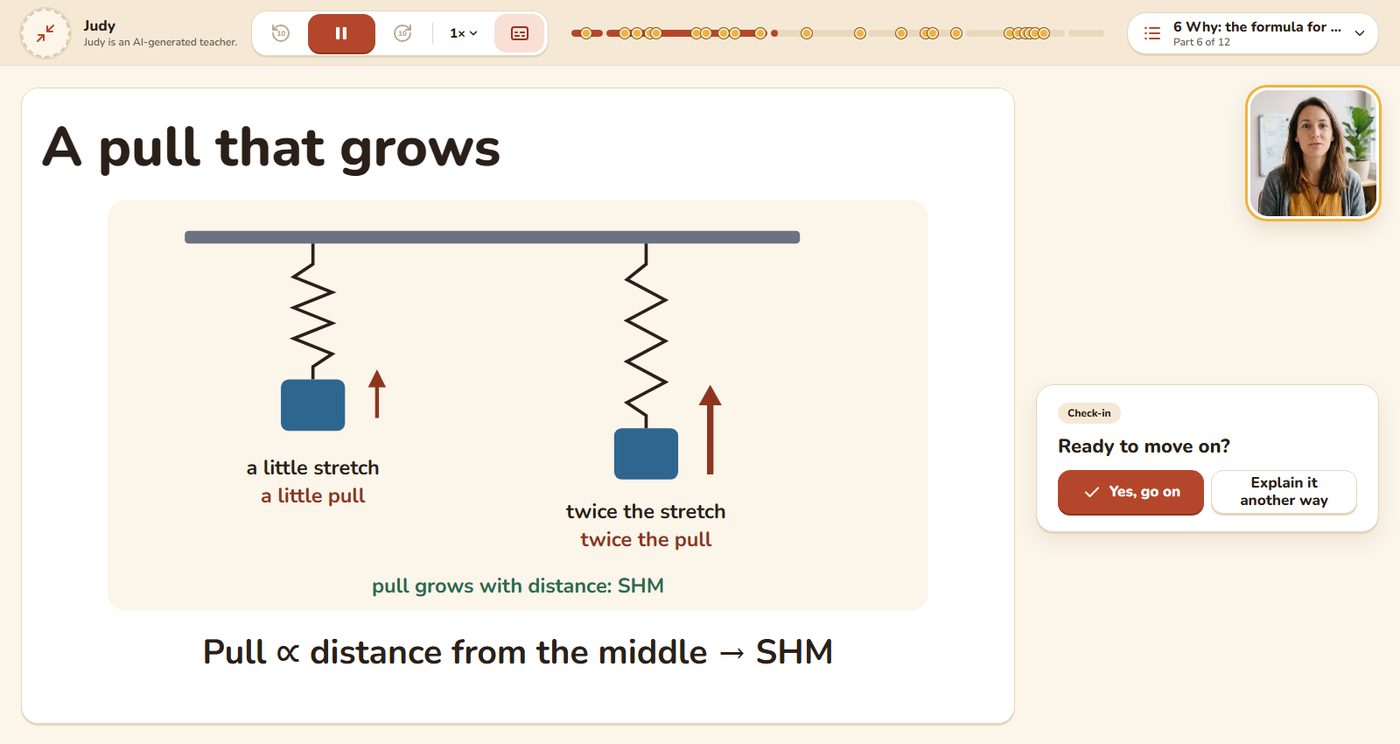
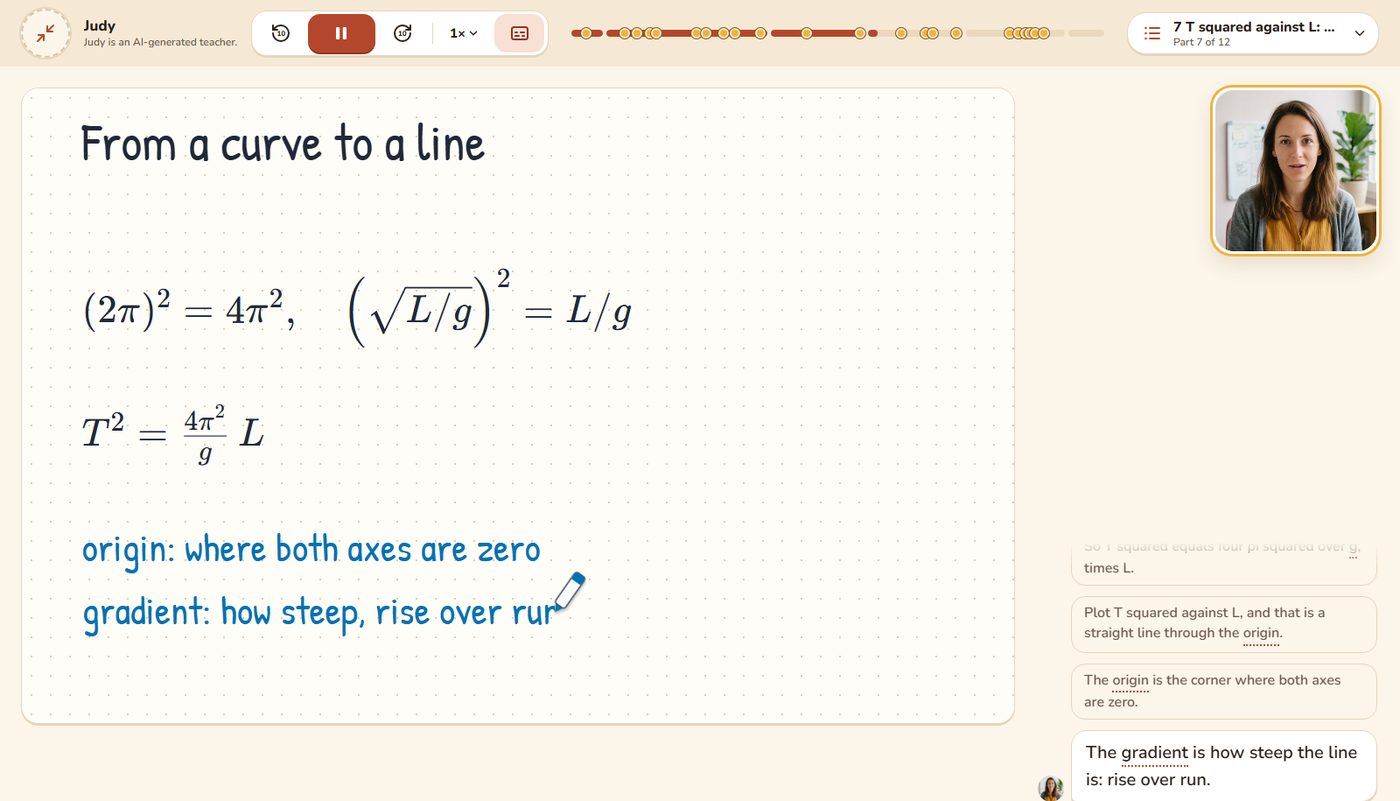
An AI teacher who speaks, listens and draws on the board, with labs and questions built into the class. These are still pictures from our physics classes.

The physics classroom: the teacher on screen and the board.
The teacher on screen, and the board.
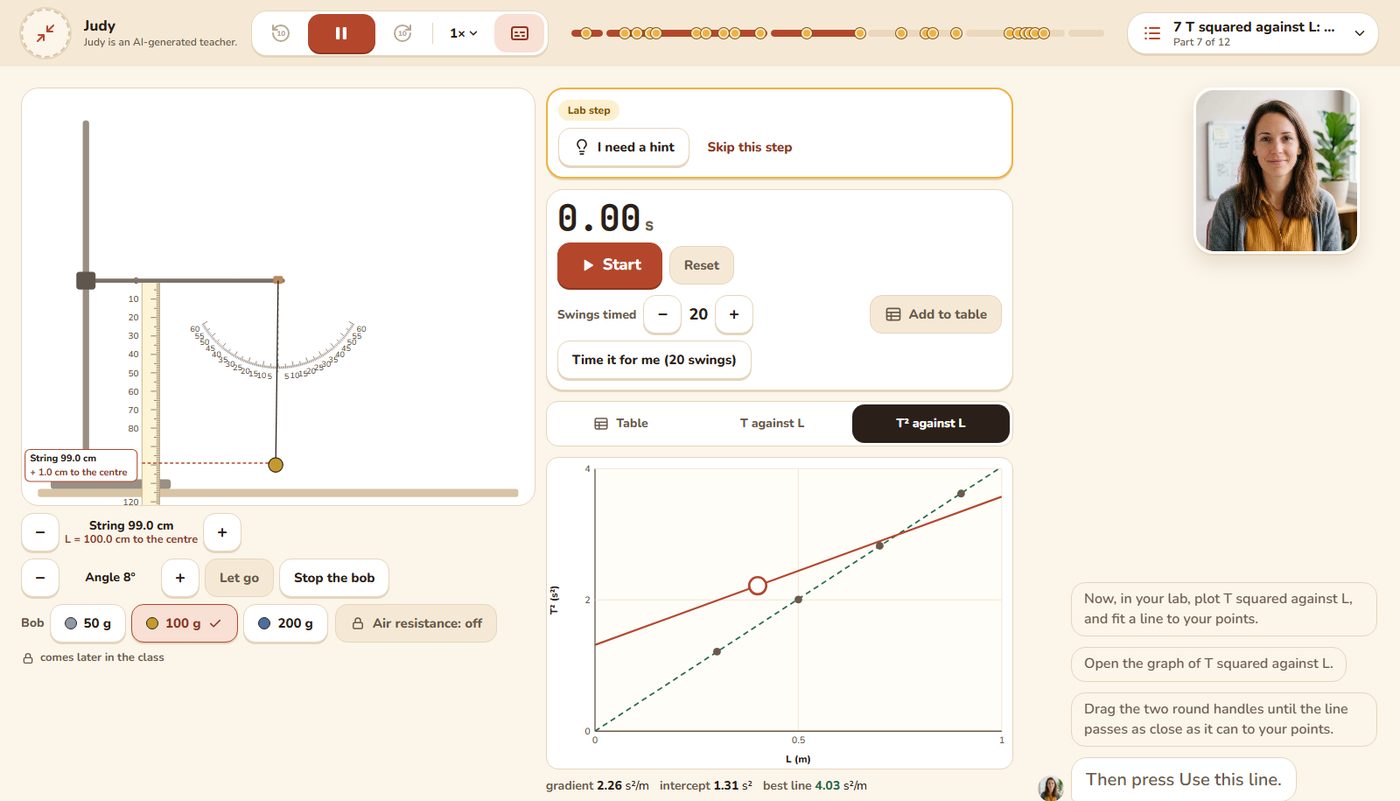
The pendulum lab: the student changes the length and takes readings.
The pendulum lab.
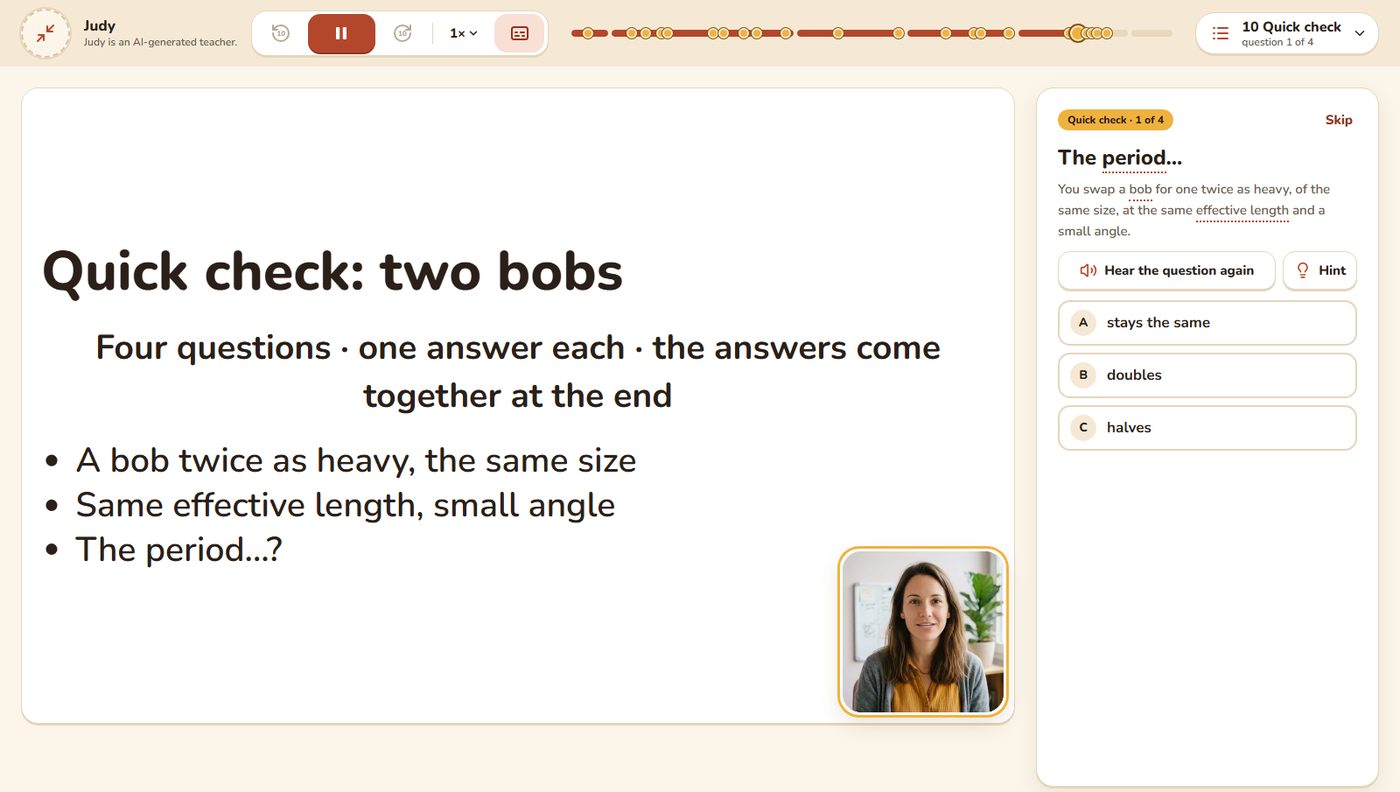
A lesson stop: ready to move on, a hint, another example, or explain it another way.
A stop to check understanding.
A question in the class.
Questions, marked as the student goes.

Your choice

On your premises, or hosted by us.

The whole system can run on your own servers, so no student data leaves the school. Or we host it for you.

Sample classes

Watch one yourself.

Two complete physics classes, with their labs. Free to watch.

CBSE · Class XI

The simple pendulum

What decides how long one swing takes? The class builds the formula step by step, then the student finds g in the pendulum lab.

About 72 minutes · with a lab

Watch the class link coming

Cambridge AS · 9702

EMF and internal resistance

Why does a battery's voltage drop when it works hard? The student measures it in the cell lab and finds the internal resistance.

About 60 minutes · with a lab

Watch the class link coming

Talk to us

Tell us what you teach.

[email protected]

Tell us your syllabus, your grades and how you like to teach. We come back with a plan for your approval.